
See your property value instantly
Searching...
Takes 10 seconds. No commitment.
Travis County property owners understand the variables with property taxes, especially as property values in and around Austin continue to rise. Fortunately, homeowners have the right to protest their Travis County property tax value every year.
Determined by the Travis Central Appraisal District (TCAD)
Set by local taxing entities like the city, county, and school districts.
Your property tax bill is calculated by multiplying your property’s taxable value by your local tax rate. Tax rates cannot be protested, but if you think your Travis County property’s market value is too high, you should file a protest.
Home Tax Shield makes it easy and fast. We blend data science, local expertise, and deep experience to ensure homeowners know if they’re overpaying each year and keep more of their money.
Travis County property values are some of the highest in the state, and they continue to rise every year. As with many counties, the Travis Central Appraisal District relies on mass appraisal models to determine market value, using formulas to compare your property to others in your neighborhood instead of firsthand evaluations.
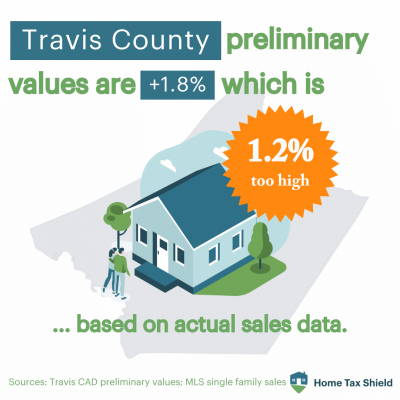
It’s no wonder that so many properties are overvalued, and why tens of thousands of Travis County property owners file a property tax protest every year. Even a small reduction in your property’s market value can lower your tax bill for years to come.
Unclaimed savings
Claimed savings
Average tax reduction
Source: 2015-2019 Operations Survey Data (comptroller.texas.gov). Estimates assume average property tax rate of 2.2% and the state average reduction of 5.2% due to data inconsistencies in underlying county data.

If you’ve received your Notice of Appraised Value from the Travis Central Appraisal District and believe your value is too high, here’s what typically happens:
File a protest with the Travis Central Appraisal District (usually by mid-May).
Participate in an informal review, where an appraiser may offer to adjust your value.
Attend a formal hearing before the Appraisal Review Board (ARB) if needed.
Receive a final determination—either a reduction or confirmation of your value.
You have the option to represent yourself or hire professionals like Home Tax Shield to manage everything for you. Our team reviews comparable sales, local trends, and data from the Travis Central Appraisal District to build your strongest case.
File and manage your protest from start to finish
Assign licensed, experienced professionals who represent you at every hearing
Charge a fair upfront fee so every case gets full attention
Deliver the highest reductions possible using every allowable data point
In short, it matters who works your case. Many competitors don’t attend hearings or rely on low-effort models. We show up, we fight for fairness, and we follow through to the end.

Travis Central Appraisal District
850 East Anderson Lane, Austin, TX 78752
P.O. Box 149012, Austin, TX 78714-9012
(512) 834-9317
Around May 15 (check TCAD website for updates)
Travis County, Travis County Healthcare District, Austin Community College District, various Independent School Districts, one or more Special Districts, and others
Compare your value to similar homes in your area—but remember, accurate comparisons require adjustments for features, age, and condition. That’s where our data-driven analysis helps. Only with Home Tax Shield will you know for sure if it’s too high or fair.
Typically around May 15, but the exact date can vary. Always confirm with the Travis Central Appraisal District.
Yes. Even small reductions compound over time. Homeowners who protest annually save thousands over the years.
Yes. If your property is unequally appraised compared to others, you may still qualify for a reduction.
Your current value stays the same, and there’s no penalty for protesting.
Stay informed about recent developments affecting Travis County homeowners:

Proposed increases to the homestead exemption and lower caps on annual appraisal growth could impact Travis County homeowners.

According to the Austin American Statesman, the property tax increase will fund flood recovery, road projects and public safety.

The Texas Tribune reports on the “spotty” disaster aid in rural areas and its impact.
If you live in Travis County, there’s a good chance you’re overpaying property taxes. You have the right to protest, and Home Tax Shield offers you experienced professionals and advanced data to save you time and headaches while ensuring you’re paying only what’s fair.